Wir durchsuchen 2.024.886 Objekte für Sie.



Auktion: 11 Tage
Stand 28.05.2026
ERNST, MAX
1891 Bruehl–1976 Paris
Title: Trophée Hypertrophique.
Date: 1919/20.
Technique: Cliché printing and ink on paper.
Measurement: 38 x 19.5 cm.
Notation: Dedicated and signed lower right: for Tristan Tzara max ernst.
Frame: Framed. Not examined out of the frame.
The additions in ink make this a one-of-a-kind piece
Provenance:
- - Tristan Tzara Collection, Paris
- Albert Loeg & Krugier Gallery, New York
- Galleria Arturo Schwarz, Milan
- Galerie Jan Krugier, Geneva
- Ernst O. E. Fischer Collection, Krefeld
- Private collection, North Rhine-Westphalia
Exhibition:
- Galerie Au Sans Pareil, Paris 1921, cat. no. 44
- Musée National d'Art Moderne, Paris 1959, cat. no. 121
- Albert Loeb and Krugier Gallery, New York 1968, cat. no. 28
- Galleria Galatea, Turin 1969 (label)
- Württembergischer Kunstverein, Stuttgart 1970, cat. no. 18
- Musée d'Art et d'Histoire, Geneva 1970, cat. no. 99
- Krefelder Kunstverein, 1972 (label)
- Kunsthaus Zürich, 1978 (label)
- The Seibu Museum of Modern Art, Tokyo 1977 (label)
- Nationalgalerie Berlin, 1977 (label)
- Kölnischer Kunstverein, Cologne 1980 (label)
- Kunstmuseum Bonn, 1980 (label)
- Max Ernst Kabinett, Brühl 1982 (label)
- Kunstmuseum Bern, 1988 (label)
- Hamburger Kunsthalle, 1989 (label)
- Kunstsammlung Nordrhein-Westfalen, Düsseldorf 1989 (label)
- The Tate Gallery, London 1991 (label)
- The Metropolitan Museum of Art, New York 2005 (label)
Literature:
- Spies, Werner (ed.): Max Ernst – Catalogue Raisonné, Works 1906–1925, Houston/Cologne 1975, cat. no. 302, ill.
- Waldberg, Patrick: Max Ernst, Paris 1958, p. 147, ill.
- Schneede, Uwe M.: Max Ernst, Hatje Bildmonographie, Stuttgart 1972, p. 21, no. 31
- Exhibition catalogue: Max Ernst – Collages, Inventory and Contradiction, Cologne 1988, p. 41ff.
- A rare, sought-after print from Ernst’s experimental Dada period
- Impressive exhibition history
- With a personal dedication by the artist to his friend Tristan Tzara – writer and co-founder of Dadaism
- Further examples are held at the Centre Pompidou, Paris, and the Museum of Modern Art, New York
The cliché print *Trophée Hypertrophique* was created during a period when Max Ernst was intensely engaged in developing his collages. A new type of work emerged from drawings and the use of printing techniques. One of the printing techniques Max Ernst employed was the so-called cliché print. In late 1919, the artist spent several intensive months at the Max Hertz printing works in Cologne. Max Ernst assembled his prints from the line etchings available there, which were originally intended for technical publications. Even as a child, he was fascinated by mathematical formulas and technical drawings, which in their form represent nothing other than their function. The selection of the subsequent repertoire of forms is not related to what was available at the print shop, but rather suggests what matters most to Max Ernst in his works: the pictorial elements should be as minimal as possible and contain no text fragments. In the case of the work “Trophée Hypertrophique”, too, it is only at second glance that one realises that it is not a depiction of a single apparatus, but rather a combination of various technical illustrations. Using restrained lines, Max Ernst connects the individual elements, thereby creating a fictional apparatus. The dedication to Tristan Tzara makes this copy a unique sheet, illustrating the artistically productive milieu in which Max Ernst moved and worked. Tristan Tzara was himself an artist and author, one of the founders of the Dada movement in Zurich, and maintained close contact with the other Dada founders in Berlin, Paris and Cologne, where Max Ernst was a founding member. The Cologne group pursued primarily political goals and placed the questioning of bourgeois art reception at the forefront. Max Ernst’s cliché prints play with precisely this understanding of art and the modes of reception. With his collage-like prints, Max Ernst challenges the contemporary concept of art. The cliché print “Trophée Hypertrophique” thus stands in a special way for the development of art after the First World War: this particular work represents Max Ernst’s artistic innovations whilst also highlighting the international connections of the Dada movement.
Estimated shipping costs for this lot:
The lot is unsuitable for parcel shipping. Transport only by shipping company after consultation following the auction.
additional shipping insurance
Shipping insurance
up to total invoice amount of 25,000 Euros: max. 41.65 Euro
over a total invoice amount of 25,000 Euros: 1.8 o/oo
USA by individual arrangement after the auction.
#Max Ernst #Rhenish Expressionism #Dadaism #Surrealism #France #Modern Art #1910s #Modern Art.
In accordance with §26 UrhG (German Copyright Act), VAN HAM is obliged to pay a statutory resale royalty on the sale proceeds of all original works of fine art and photography whose authors have not been deceased for 70 years prior to the end of the calendar year of the sale. The buyer shall contribute 1.5% of the hammer price to this fee.




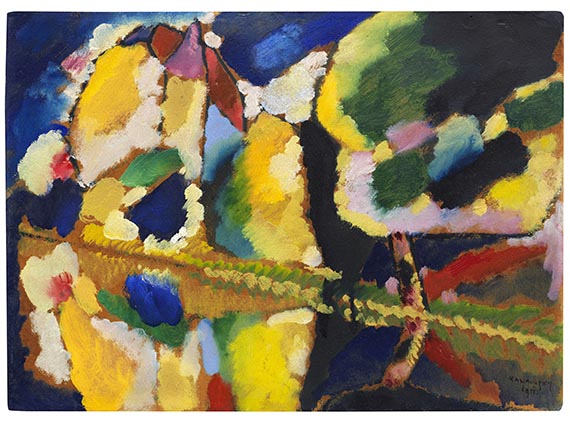
 Wassily Kandinsky
 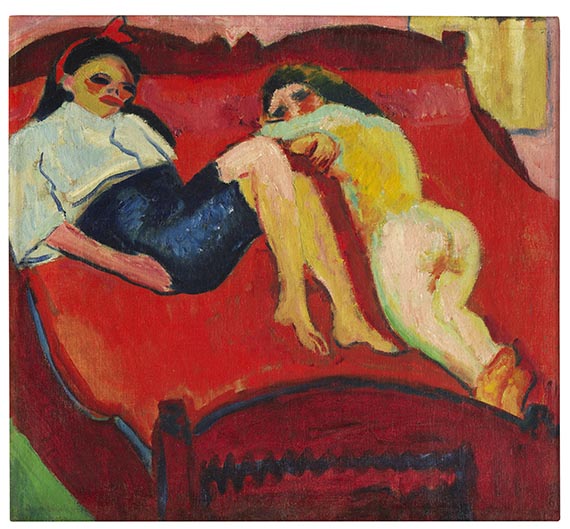 Hermann Max Pechstein
  Francis Picabia
  Ernst Ludwig Kirchner
  Emil Nolde
  Lyonel Feininger